China conducts realistic amphibious warfare drills
A Chinese naval amphibious ship group has carried out multi-subject, combat-oriented training in offshore waters, testing integrated air defense, electronic warfare, and amphibious assault operations,
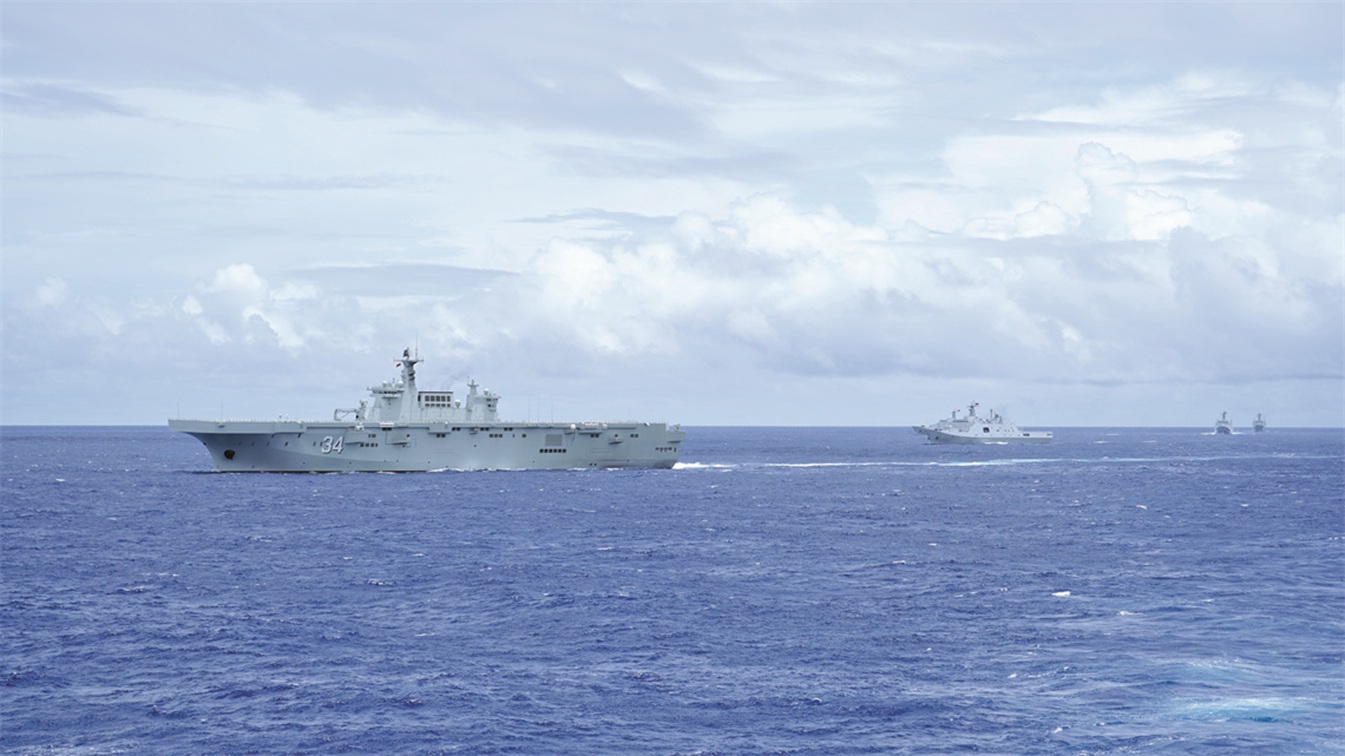
A Chinese naval amphibious ship group has carried out multi-subject, combat-oriented training in offshore waters, testing integrated air defense, electronic warfare, and amphibious assault operations, according to a report published by the PLA Daily.
The report said multiple vessels, including the Type 075 Hubei ship, formed a task group and sailed to a designated sea area to conduct several days of live-force training under winter conditions. The drills were designed to strengthen system-level combat capabilities and improve coordination across ships, aircraft, and landing forces.
“An unidentified aerial target detected!” the report said, describing the opening phase of the exercise. As the formation arrived in the task area, combat alarms sounded and crews moved to battle stations. Radar operators in the Hubei ship’s combat information center reported multiple fast-approaching targets. Commanders assessed the situation and ordered the formation to adjust course and spacing to establish an air defense posture.
At the order to engage, close-in weapon systems opened fire, destroying simulated aerial targets, the report said. At the same time, electronic warfare personnel identified incoming “enemy” missiles and selected appropriate countermeasures. Several decoy rounds were launched, creating what the report described as an “electromagnetic fog” that successfully diverted the simulated missiles away from the ships.
A unit commander told PLA Daily that since entering service in the second half of this year, the Hubei ship has taken part in multiple combat-oriented exercises. “The system-level combat capability has been effectively tempered, and the troops’ combat awareness has improved markedly,” the commander said.
The commander added that the training was conducted in a complex battlefield environment, with scenarios designed to be demanding and realistic. “We focused on setting difficult conditions and realistic contingencies to further test the officers’ and sailors’ ability to apply tactics and handle emergencies,” he said.
The exercise then shifted to amphibious assault operations. “Transport landing forces!” an order was issued, prompting the crew to secure shipborne helicopters and complete vehicle-aircraft coordination procedures. Using internal elevators, helicopters were transferred to the flight deck for launch.
On the flight deck, deck crews released tie-downs as multiple shipborne helicopters lifted off in sequence, carrying landing troops. The helicopters flew at very low altitude toward simulated enemy depth areas, practicing penetration tactics. Simultaneously, the Hubei ship’s well deck stern gate and ramp were opened, and crews began final preparations to deploy air-cushion landing craft.
“Maintain course and watch hull attitude!” the report said, describing the launch sequence. Inside a landing craft cockpit, a non-commissioned officer guided the craft smoothly out of the mother ship. Multiple air-cushion landing craft then advanced over the waves toward their objective.
As helicopters completed the first wave of troop insertion, they regrouped and returned along landing patterns toward the Hubei ship. Radar operators continuously reported relative positions between ships and aircraft. Under the direction of deck controllers, helicopters landed one by one on the flight deck, where deck crews quickly secured them and connected refueling lines. Shortly afterward, the helicopters took off again to continue operations.
PLA Daily reported that the training lasted several days and included air defense and missile defense, integrated offense and defense, and coordinated ship-aircraft operations. The goal, the report said, was to further improve the formation’s system-level combat effectiveness.
Chinese military reporting has increasingly highlighted such exercises as part of efforts to prepare units for complex maritime operations.
Readers who wish to follow our weekly coverage can subscribe to the Weekly Defense Roundup.
If you wish to report a grammatical or factual error in this article, please let us know by using the online form.
Support Independent Defense Reporting