U.S. military eyes REGENT’s revolutionary autonomous seaglider
Preparing for future military and humanitarian operations across vast oceanic regions, United States military planners and their partners are exploring the potential use of the Squire Autonomous Seagl
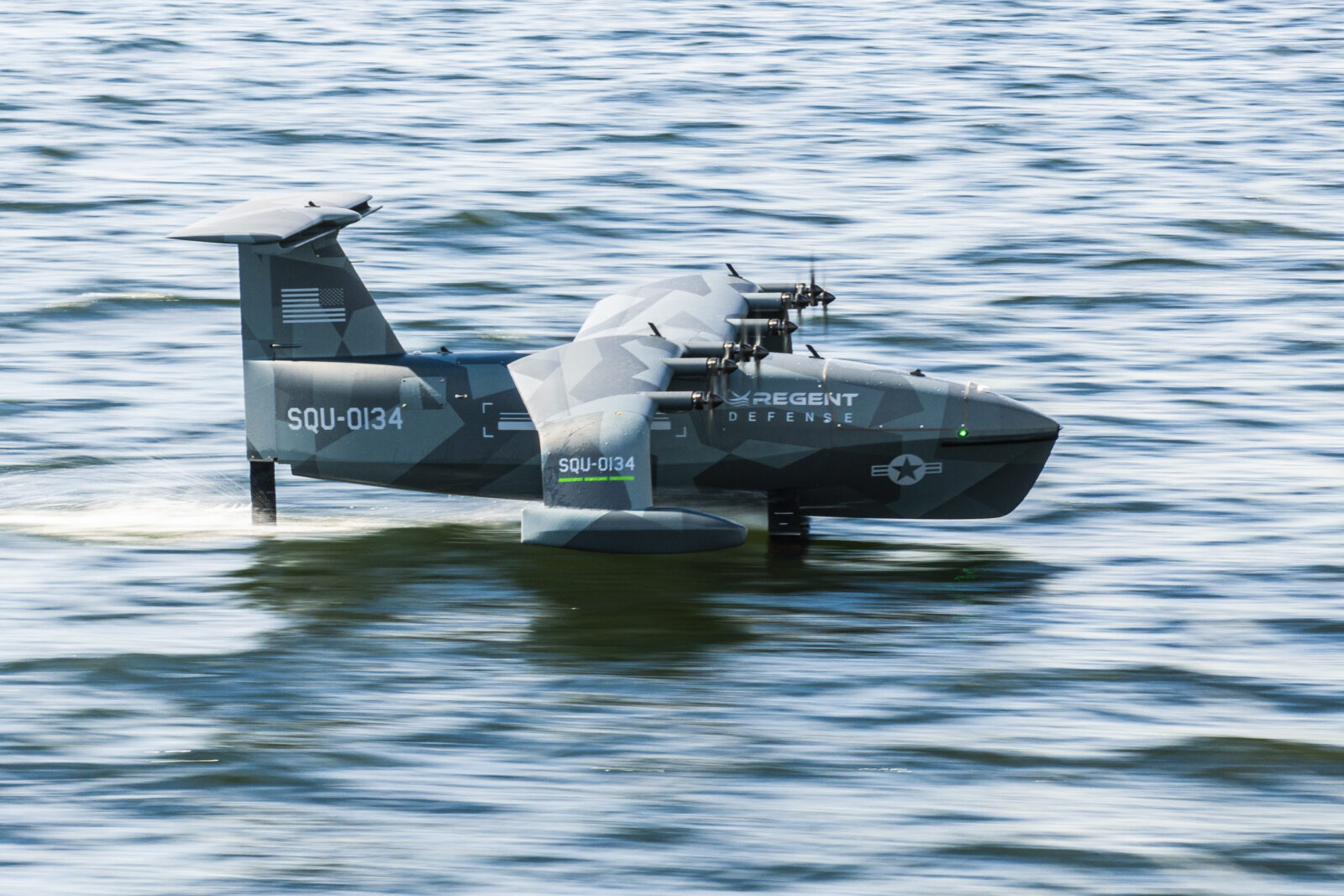
Preparing for future military and humanitarian operations across vast oceanic regions, United States military planners and their partners are exploring the potential use of the Squire Autonomous Seaglider as a fast, low-signature platform for cargo delivery and multi-mission support with a high degree of autonomy and operational safety. Developed by U.S.-based innovation company REGENT, the hybrid unmanned vehicle is designed to move supplies and information across contested maritime environments while reducing dependence on traditional infrastructure, while also supporting reconnaissance, infiltration and exfiltration tasks, special operations missions, as well as casualty and medical evacuation roles.
The Squire Autonomous Seaglider combines characteristics of a surface vessel and an aircraft. Using hydrofoils, the vehicle lifts out of the water before transitioning into low-altitude flight just above the sea surface, operating in ground effect to improve efficiency and reduce detectability. Because the platform does not require a runway or prepared landing zone, it can reach remote coastal areas and dispersed island positions where conventional aircraft or ships face operational limitations.
Externally, the platform measures approximately 13 feet in length, 5.5 feet in height, and features an 18-foot wingspan. The internally mounted payload bay measures 14 inches in length, 12 inches in height, and 14 inches in width, providing a total internal payload volume of 2,400 cubic inches for logistics, ISR equipment, or mission-specific cargo. The system is designed to operate at hydrofoil speeds of about 35 knots and reach a top speed of up to 70 knots in ground effect flight, with an operational range of approximately 100 nautical miles.
The platform recently drew attention following a defense briefing in Quonset, Rhode Island, attended by United States Secretary of War Pete Hegseth and senior defense officials, prompting broad discussion within the defense community about the future role of hybrid autonomous maritime systems.
Seeking to better understand the operational thinking behind the program, we spoke with General Manager, REGENT Defense, Tom Huntley.
Q: What operational requirement led REGENT to pursue a hybrid maritime autonomy platform combining unmanned surface and aerial capabilities within Squire?
“We established REGENT Defense alongside our commercial offering because we recognized that Seaglider vessels offer a multi-mission maritime solution that can serve to protect our national interests along our coasts and around the world. Across multiple missions, Seagliders can be used to protect our warfighters by projecting maritime power, enabling persistent maritime presence, reducing operational risk, and enabling uninterrupted information and supply chains. At its core, Squire was developed to support this vital maritime mission set.
Modern forces are increasingly dispersed across maritime zones where traditional logistics platforms are too large, visible, and vulnerable. Commanders need a discreet, persistent way to resupply units in these high-threat areas without dependence on vulnerable infrastructure or support assets. By combining unmanned surface and low-altitude flight capabilities in a single autonomous platform, Squire can deliver fuel, ammunition, food, and medical supplies to forward units with a far smaller footprint than existing military assets.”
Q: During your briefing with the Secretary of War, you noted Squire’s ability to augment legacy platforms. How do you see it integrating alongside existing naval and aviation assets?
“REGENT is a proud and trusted partner of the U.S. Department of War and the U.S. Marine Corps, with a growing contractual relationship with the Marines that began in 2023 as part of its strategic shift toward distributed maritime operations. Squire will support existing military assets, having been designed to augment, not replace, legacy naval and aviation platforms by taking on the high-risk, high-frequency logistics, ISR, and resupply missions that currently tie up crewed assets.
By operating autonomously in contested littoral zones, Squire can handle routine and persistent delivery of supplies, ammunition, medical equipment, and intelligence, thereby allowing manned ships and aircraft to focus on complex, high-value combat and command roles. It can plug directly into current maritime and aviation logistics chains, without requiring changes to how those forces operate.”
Q: Many contested regions lack reliable airfield infrastructure. How was Squire designed to operate effectively in austere environments such as dispersed islands or remote coastal areas?
“Squire was built specifically for environments without reliable airfields or port infrastructure. REGENT’s Seagliders are designed to take off from, and land directly on the water, removing dependence on runways or prepared landing zones. This capability makes it ideal for dispersed islands and remote coastal areas, where military forces often operate from temporary or mobile positions and need the versatility offered by Squire and other Seagliders in terms of deploying quickly and effectively.”
Q: Is Squire built around a modular architecture allowing rapid transition between ISR, logistics, kinetic, medical, or other mission sets?
“Squire is absolutely built with a modular architecture for rapid multi-mission capability. We know that the nature and landscape of military capability constantly changes, and the need for rapid integration is critical for any platform. We understand firsthand how the military needs platforms that can flex to mission demands, and not the other way around.
Squire’s payload bay and mission systems are designed around open architecture standards, allowing operators to swap between logistics pods, ISR sensor packages, medical equipment delivery, and kinetic payloads without requiring depot-level maintenance or specialized tooling. That flexibility is what transforms Squire from a point solution into a persistent, multi-mission asset.”
Q: In practical terms, how quickly can operators reconfigure payloads or mission packages?
“We are designing Squire with rapid reconfiguration timelines that are operationally meaningful to ensure a small forward-deployed team can turn Squire around for an emergent mission without returning to a main operating base. We’re designing the payload interfaces so that a two-person crew with minimal specialized training can execute a reconfiguration as realities change and mission requirements adapt.
In a distributed maritime operations context, where teams may be working from austere areas, forward deployed ships, or a small island with no significant logistics tail, that kind of rapid reconfiguration capability is essential.”
Q: Do you envision a single platform supporting multiple mission profiles within one operational deployment?
“Absolutely, and that’s where Squire’s differentiation and real operational value is showcased. When operating at the edge in the first island chain, a single Squire could depart on a logistics resupply run, collect ISR data along its route through its onboard sensor suite, and return with critical medical equipment or lifesaving blood to pre-stage, increasing situational awareness, readiness, and resiliency. That kind of multi-role utility within a single sortie is what gives distributed force commanders genuine operational leverage without adding to their logistics burden.”
Q: Intermodal logistics appears central to the concept. How does autonomy reduce operational risk compared with traditional manned solutions?
“Autonomy allows Squire to run preprogrammed logistics and resupply missions 24/7, removing human fatigue as a limiting factor and ensuring continuous operations in contested littoral environments. By handling high-risk, repetitive, or remote missions, Squire offers a solution to keep crews out of harm’s way and free traditional manned platforms to focus on more complex combat tasks. This is a critical capability across maritime search and rescue operations, contested logistics, and ISR.”
Q: What level of autonomy is currently implemented, and how is human oversight retained during missions?
“Squire has been designed to support an autonomy-ready navigation and control system where operators set speed, direction, and mode – hull, hydrofoil, or flight – while redundant control computers validate sensor inputs and actuate surfaces. In doing so, Squire combines human-directed command with automated execution, ensuring a safe, UMAA-compliant flight control system that is ready to integrate mission-specific USG or allied software packages. Development and validation efforts are underway to expand that capability to full mission autonomy, including mission planning, augmentation, rerouting, and execution, all while having humans in the loop for critical mission decisions and oversight.”
Q: Which operational challenges most influenced the platform’s design priorities?
“First is the tyranny of distance. The first island chain is a geography that punishes traditional logistics. Airfields are limited, contested, and as fixed infrastructure are certainly vulnerable to attack. Port infrastructure is sparse and equally at risk. Squire was designed specifically to eliminate dependence on both, as it can operate independent of traditional fixed infrastructure.
Second is signature management. In that operating environment, visibility is a liability. Squire’s low-altitude operational profile flying in ground effect skimming the sea surface makes it inherently difficult to detect and track compared to conventional aircraft or surface vessels.
Third is persistence. Defense officials there and elsewhere consistently push back on platforms that require significant forward basing and crew rotation to sustain operations. Squire’s autonomous, 24/7 capable design directly addresses that requirement.”
Q: What has been the most difficult aspect of developing a system that bridges maritime and aerial operational domains?
“Developing a system that operates effectively across both water and air requires rigorous engineering and extensive testing to ensure performance, safety, and reliability. We have optimized Squire across both hydrodynamic and aerodynamic operational regimes to deliver capability in speed, endurance, and multi-mission functionality. Balancing the unique demands of maritime and aerial operations is complex as we maintain speed, payload, and low observability capability criteria. Testing and refinement continue today to ensure Squire meets the high standards required for contested and remote environments.”
Q: What upcoming milestones should observers watch for in the Squire program?
“The Squire Seaglider prototype has been cleared for testing by the U.S. Coast Guard and is currently undergoing a thorough testing program and envelope expansion campaign, validating autonomy, range, payload, and sensor interoperability. We have been invited to participate in some key U.S. military wargames this year that will further mature the operational capability of Squire and accelerate delivery to operational commanders.”
Q: How do you see maritime autonomy evolving over the next decade?
“Over the next decade, maritime autonomy will play an increasingly vital role in closing operational gaps in contested logistics, MEDEVAC, ISR, and counter-narcotics, where speed, persistence, and low observability are critical. The ‘6th domain’ – ultra-low altitude operations just above the sea surface in ground effect – is emerging as a key battleground in future maritime conflicts, and platforms like Squire show how agile, emerging defense companies can rapidly deliver mission-ready capabilities to support this key space.
We expect to see hybrid systems like Squire become the norm, combining surface, aerial, and autonomous capabilities to operate in contested and remote environments. Over the next decade, autonomy will be central to reducing risk to personnel, increasing operational abilities, and giving the military more resilient and adaptable options across the maritime space.”
—
The unveiling of Squire has sparked wide discussion across the defense expert community, reflecting growing interest in hybrid autonomous platforms capable of reshaping maritime operations. By combining surface mobility, low-altitude flight, and autonomous logistics capability, Squire is designed to address a central operational challenge facing modern forces: sustaining forward units in contested environments without reliance on vulnerable infrastructure while reducing risk to personnel.
For defense observers, the system highlights a broader shift toward distributed operations where persistence, reduced detectability, and infrastructure independence are becoming core requirements. As militaries adapt to dispersed theaters and contested coastal regions, platforms such as Squire illustrate how autonomy and multi-domain mobility are increasingly viewed as practical tools for maintaining operational continuity under threat.
Readers who wish to follow our weekly coverage can subscribe to the Weekly Defense Roundup.
If you wish to report a grammatical or factual error in this article, please let us know by using the online form.
Support Independent Defense Reporting
Корабли
- SSBN-740 Rhode Island