US Navy P-8A Patrols the Eastern Black Sea, Keeping Pressure on Russia’s Main Fleet Hub
Today, a US Navy Boeing P-8A Poseidon conducted a long surveillance mission over the eastern Black Sea, focusing its activity south of Novorossiysk. The patrol unfolded in international airspace but c
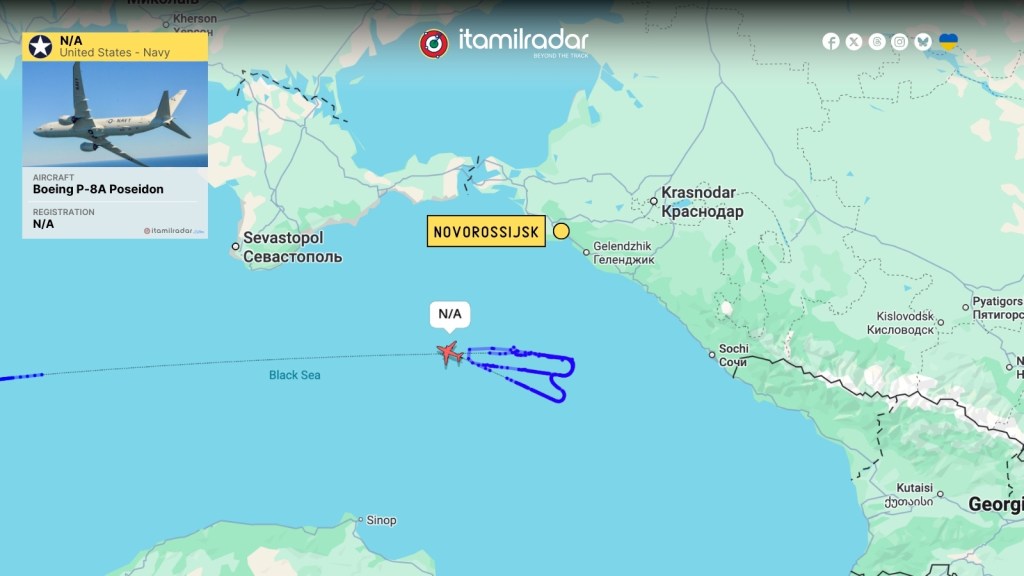
Today, a US Navy Boeing P-8A Poseidon conducted a long surveillance mission over the eastern Black Sea, focusing its activity south of Novorossiysk. The patrol unfolded in international airspace but clearly oriented toward Russia’s most important remaining naval base in the region, underscoring why this area continues to matter strategically after months of sustained tension.
Flight-tracking data shows the Poseidon operating well offshore, following repeated patterns consistent with intelligence, surveillance, and reconnaissance activity. While such missions are now a regular feature of the Black Sea air picture, the specific focus on the Novorossiysk area is not accidental. Since the start of the war in Ukraine, and even more so in recent weeks, Novorossiysk has become the backbone of Russia’s Black Sea Fleet, compensating for the reduced usability and vulnerability of Sevastopol.
The timing is also relevant. In recent days, Russian naval and military activity in the eastern Black Sea has drawn renewed attention, with Novorossiysk once again at the center of logistical, defensive, and operational arrangements. For NATO and the United States, maintaining persistent awareness around this hub is essential to understanding fleet movements, port activity, and potential changes in posture.
The Boeing P-8A Poseidon is particularly well suited for this task. Designed for maritime patrol and ISR missions, it combines long endurance with a broad sensor suite, allowing it to monitor surface vessels, maritime traffic, and coastal activity from international airspace. Although no direct interaction was reported during today’s mission, the presence of such an asset sends a clear signal: the area is being watched continuously.
This kind of patrol has become a familiar pattern since the outbreak of the conflict, yet it has gained additional weight as Russia has increasingly relied on Novorossiysk as its primary Black Sea stronghold. Repeated Ukrainian strikes and the persistent threat environment around Crimea have reshaped Russian naval behavior, making the eastern Black Sea a key zone for both protection and projection.
From a broader perspective, today’s flight fits into a sustained strategy rather than an isolated event. By regularly deploying high-end ISR assets to the Black Sea, the United States reinforces situational awareness for NATO while also demonstrating freedom of navigation and overflight in accordance with international law. These missions are not about escalation but about consistency and visibility.
In strategic terms, Novorossiysk is no longer just a secondary port; it is the linchpin of Russia’s Black Sea naval presence. Each patrol that focuses on this area reflects an acknowledgment of that reality. As long as the war continues and Russia’s naval posture remains constrained, surveillance missions like today’s will likely remain a constant feature of the Black Sea security landscape.
For observers, the message is clear: even routine flights can reveal where the real centers of gravity lie, and today, once again, Novorossiysk stood out as one of them.