USS Gerald R. Ford Stops in Souda Bay – Forward Presence Signals US Readiness Amid Iran Tensions
The USS Gerald R. Ford has arrived in Souda Bay, Crete, for a port stop while en route to the Eastern Mediterranean. The US Navy’s most advanced aircraft carrier reached the strategic NATO hub today,
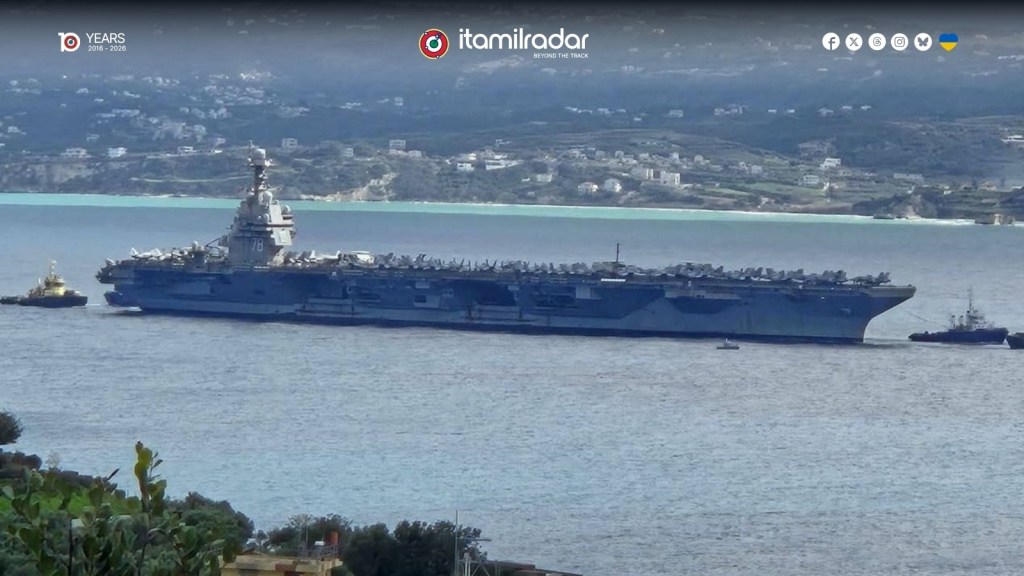
The USS Gerald R. Ford has arrived in Souda Bay, Crete, for a port stop while en route to the Eastern Mediterranean. The US Navy’s most advanced aircraft carrier reached the strategic NATO hub today, following days of transit across the Atlantic and through the Strait of Gibraltar. The stop comes amid renewed tensions with Iran and reinforces Washington’s forward posture in a region that could rapidly escalate.
The presence of the USS Gerald R. Ford in Souda Bay is far from symbolic. The carrier strike group, centered on the US Navy’s flagship, represents one of the most powerful naval formations currently deployable. Its arrival follows yesterday’s reporting on the carrier’s eastbound movement, widely interpreted as part of a broader US force repositioning toward the Eastern Mediterranean and potentially the Gulf.
A Strategic Pause Before Moving East
Souda Bay has long served as a logistical and operational hub for US and NATO naval forces operating in the Mediterranean. A stop here allows for resupply, crew rest, coordination with regional partners, and final operational adjustments before proceeding further east.
In recent days, the United States has significantly reinforced its regional posture, with tankers, ISR platforms, fighters, and additional naval assets moving toward Europe and the Middle East. The Ford’s arrival fits into this larger pattern. While officially described as a routine deployment, the timing leaves little doubt about its strategic backdrop.
The carrier’s air wing provides a flexible mix of strike, air superiority, electronic warfare, and early warning capabilities. Positioned in the Eastern Mediterranean, it would be within operational reach of multiple theaters, including the Levant and, if required, areas linked to potential contingencies involving Iran.
Whether this marks the start of a prolonged forward deployment or simply a calibrated show of force remains unclear.
Deterrence Signaling Toward Tehran
The renewed friction between Washington and Tehran has already triggered visible force movements. By pushing a carrier strike group closer to the region, the US strengthens both deterrence and rapid response capacity.
A forward-deployed carrier reduces reaction time, enhances airpower availability without reliance on host-nation basing, and signals political resolve. It also reassures regional partners who are closely watching developments after weeks of escalating rhetoric and military signaling.
Souda Bay’s geography is key. From Crete, naval forces can quickly pivot toward the Eastern Mediterranean, the Suez transit route, or remain positioned to support operations extending toward the Gulf. This flexibility is precisely what makes the Ford’s current location strategically relevant.
In the coming days, the next movement of the carrier strike group will be telling. A continued eastward transit would confirm a sustained forward positioning linked to Iran-related contingencies. A longer stay in the Mediterranean, instead, would suggest a posture of calibrated deterrence rather than immediate operational preparation.
For now, the USS Gerald R. Ford’s stop in Souda Bay underscores one clear message: the United States is ensuring that its most capable naval asset is in place, at the right time, should the regional crisis deepen further this week
Корабли
- CVN-78 Gerald R. Ford
- SSN-787 Washington